
What is MCP and why do I care?
- Agentic Systems
If you want one line to help the concept land: MCP is a universal standard that lets AI models connect to and use outside tools and data, the same way USB lets any device connect to any computer.
I wanted to learn more about building AI systems. This was a new space for me. I’d been in software development for almost a decade, but AI has changed how people build systems and the options they have when designing and architecting. My first question about MCP was whether it was basically a REST API and how it was different.
That's a reasonable question if you've spent years in product and working embedded on engineering teams. When something new shows up, you reach for the closest thing you already understand and use that to build a mental model of the new thing.
I got back an answer that was correct and well organized. It sounded reasonable. It had a comparison table. It used the phrase "bidirectional, session-based." And it totally went over my head. I read it twice and understood nothing new.
So I tried again: "Maybe a better question is to ask you to give me the fundamental description of MCP. Let's start at the beginning."
That second question worked, and it was helpful. I thought I would write up what I learned here for you. If you run a business and keep hearing that AI "agents" are about to do real work for you, MCP is a big part of what makes that possible. You don't need to be technical to understand it. You need to start with the problem it seeks to solve.
AI is isolated by default
When you chat with an AI model like Claude or ChatGPT, it only knows what's in the conversation. It can't see your email, check your calendar, look up a customer, or open your files unless something connects it to them.
Here's what that looks like in practice. Picture Ridgeline Llama Caddies, a small outfit that rents trained llamas to carry golf bags on mountain courses. (Stay with me.) A golfer emails to ask whether Gertrude, the calm one, is free for an 8:10 tee time on Saturday. An AI assistant can write a perfectly friendly reply. What it can't do is check Gertrude's schedule, confirm she's cleared for a 40-pound tour bag, or put the booking on the calendar. It can sound helpful. It can't actually help.
Before MCP, fixing that meant custom work for every connection. Hooking the AI up to email took one set of code. The booking calendar took different code. The llama health records took more code again. Every new tool was a new project, and every AI product had to repeat the work for itself. That doesn't scale, which is why most AI assistants stayed stuck in the chat window.
What MCP actually is
MCP stands for Model Context Protocol. Strip away the name and it comes down to one idea:
MCP is a shared language that AI models and business tools use to talk to each other.
Anthropic introduced it as an open standard in late 2024. In December 2025 it moved to the Agentic AI Foundation, part of the Linux Foundation, so no single company controls it. For a business owner, the practical point is that the major AI products and a growing list of software tools are building to the same standard instead of competing ones.
Think of USB
Remember when every device had its own plug? This may come as a surprise to younger readers. The printer had one cable, the keyboard another, the camera a third, and your computer needed the right port for each. USB replaced all of that with one standard. Any USB device works with any USB port, no matter who made either one.
MCP is USB for AI tools. Any AI that speaks MCP can connect to any tool that speaks MCP, without someone writing custom code for that particular pairing. Ridgeline's booking calendar gets an MCP connection once, and any MCP-compatible assistant can use it from then on.
What the AI gets when it plugs in
When an AI connects to a tool through MCP, the tool's side of the connection is called an MCP server. A server can offer the AI three kinds of things:
- Tools are actions the AI can take. "Book Gertrude for 8:10 Saturday." "Send the confirmation email."
- Resources are information it can read. "Here's this week's llama schedule." "Here's the weight-limit chart."
- Prompts are ready-made instructions the server provides. "Here's our template for a booking confirmation."
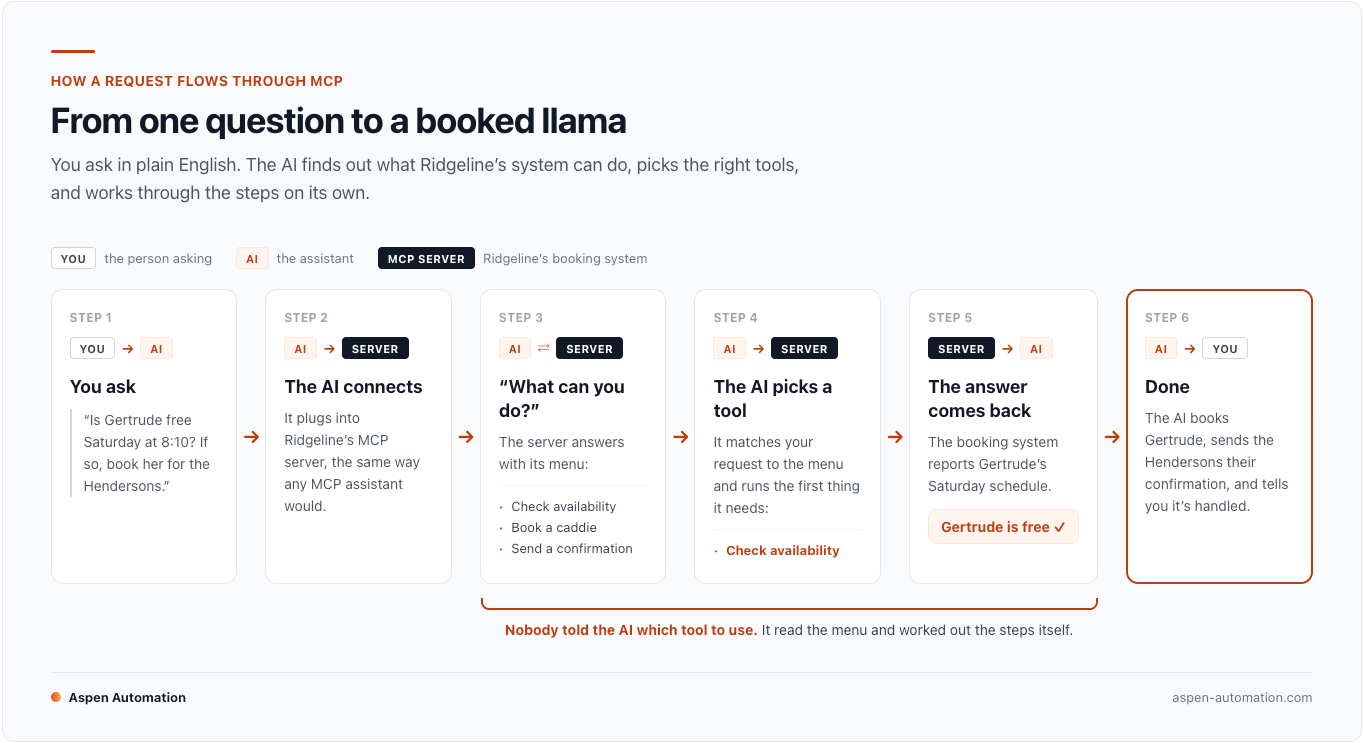
How a request actually flows
- You ask: "Is Gertrude free Saturday at 8:10? If so, book her for the Hendersons."
- The AI connects to Ridgeline's MCP server.
- The AI asks, in effect, "What can you do?" The server answers with its list: check availability, book a caddie, send a confirmation.
- The AI picks "check availability" and runs it.
- The answer comes back: Gertrude is free.
- The AI books her, sends the confirmation, and tells you it's done.
Nobody told the AI which tool to use or in what order. It read the list, matched it to your request, and worked out the steps on its own. Think about that for one more beat; you put the “menu” of what is available to the AI into an MCP server and it can reason on what is the right tool to use and when. What a time to be alive. That's the part that turns a chatbot into something closer to an assistant.
So is it like an API or not?
Now the original question has somewhere to land.
An API is how one piece of software talks to another. Think of each API as a custom-built door. It works fine, but a developer has to know exactly where it is, what key it takes, and which way it swings, then write code that opens it the same way every time. The AI on the other side has no idea the door exists.
MCP is more like a universal key standard. An AI that speaks MCP can walk up to any MCP server, ask what's behind it, and start using it without anyone hand-cutting a key first.
The two aren't rivals. An MCP server often calls ordinary APIs behind the scenes. MCP sits between the AI and your existing systems as a standard layer, so the AI doesn't need to know how each system works underneath. My first question wasn't wrong, exactly. It was the second question, asked first.
The one-sentence version
If you want one line to help the concept land: MCP is a universal standard that lets AI models connect to and use outside tools and data, the same way USB lets any device connect to any computer.
What this means for your business
For most businesses, MCP doesn't start with a build project. Many common tools already have MCP connections, so getting value often begins with connecting what you already use. The harder questions come later: which of your own systems the AI should reach, what it should be allowed to change, and who checks its work.
I dug into this because I needed to learn what an AI-first approach actually means. There are so many ways to “use AI” in your business. Understanding the methods and tools available to you when thinking about applied AI allows you to make the best decisions when designing your technology stack to use AI.
My next question was whether I'd have to build one of these myself. That's the next post. [watch for post 2]
And if you're trying to work out where AI fits in your business, or whether it fits yet, that's the conversation we like having at Aspen Automation. www.aspen-automation.com